Grape Harvesting Process: What Level 3 Requires You to Know
2026-05-10 · 4 min read
🍇 Why Harvesting Matters
Level 3 expects you to understand how harvest decisions affect grape quality, wine style, and final price.
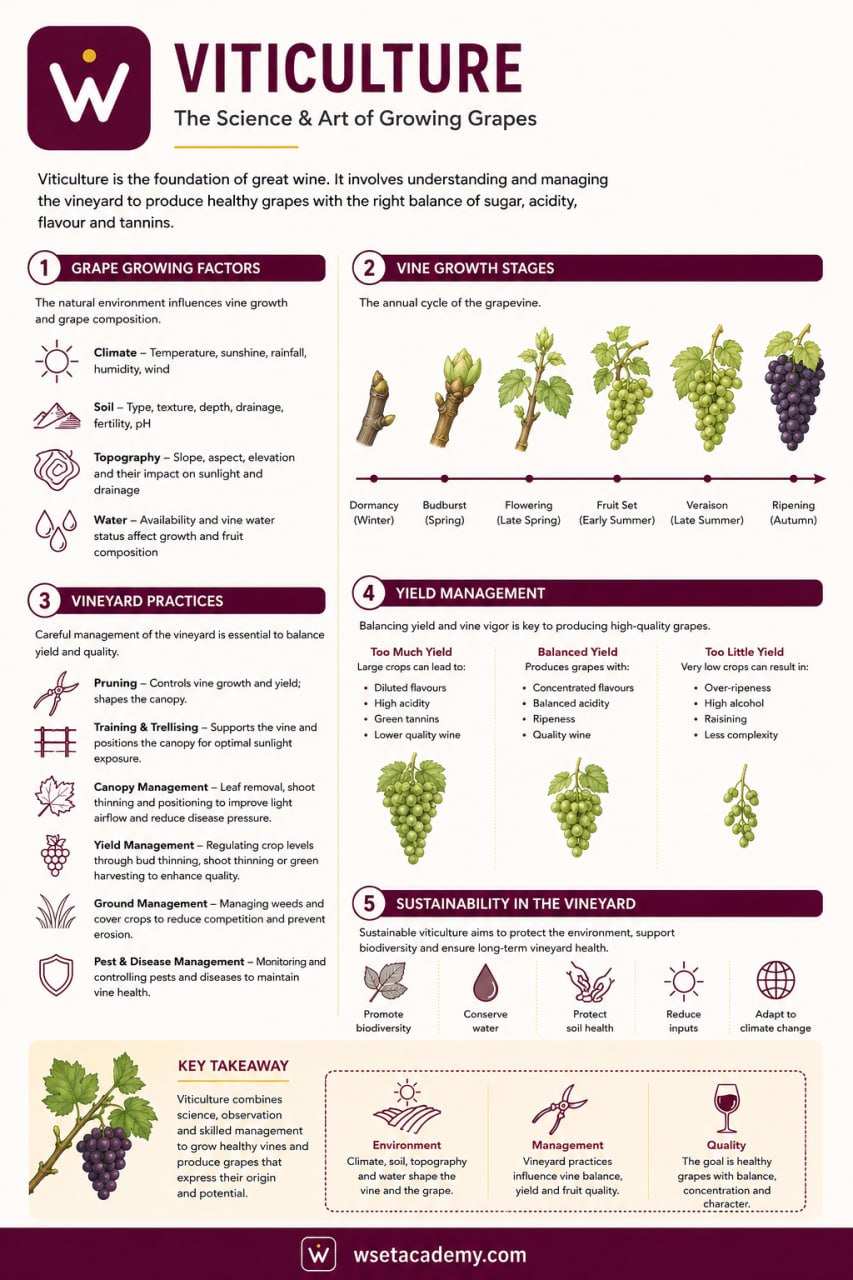
It's not just "ripe = pick" — the exam tests your grasp of ripeness in four dimensions, harvest logistics, and what happens between vineyard and crush pad.
📊 The Four Dimensions of Ripeness
Before the shears touch the vine, growers assess ripeness across four axes:
Sugar Ripeness — Measured in °Brix or Baumé. Determines potential alcohol after fermentation. Warm climates and late harvests push sugar up. But high sugar ≠ ideal harvest — sugar alone ignores balance.
Phenolic Ripeness — Tannin maturity in grape skins and seeds. This is the priority for red wines. Under-ripe phenolics produce harsh, green, astringent tannins. Properly ripe phenolics give silkier, more integrated tannins.
Flavour (Aroma) Ripeness — Optimal development of aroma compounds in the grape. These accumulate during ripening — you can't fake this later in the winery. Flavour ripeness often lags behind sugar ripeness.
Acid Balance — As grapes ripen, sugars rise and acidity falls. Growers monitor TA (titratable acidity) and pH. Too low acid → flabby, unbalanced wine. Too high acid → sharp, unpleasant. Timing is everything.
Exam tip: The sugar/acid balance is the classic trade-off question. Late harvest = more sugar + less acid. Early harvest = less sugar + more acid.
✋ Hand vs 🤖 Machine: Know the Trade-Off
Level 3 asks you to evaluate why a producer would choose one method over another. It's not "hand = good, machine = bad."
Hand Harvesting
- Selective: pickers can choose only ripe bunches and reject rot
- Gentle: whole bunches stay intact — critical for carbonic maceration and whole-bunch pressing
- Required for: quality sparkling wines, botrytised wines (individual berry selection), steep vineyard sites
- Trade-off: slower, more expensive, dependent on available labour
Machine Harvesting
- Fast: covers large areas quickly, can work at night
- Cost-effective: dramatically lower labour cost
- Suited to: large flat vineyards, warm regions, large-scale production
- Trade-off: less selective, can damage berries (oxidation risk), requires adapted trellising
Exam tip: You might be asked which harvesting method suits a particular wine style. Sparkling + steep slope = hand. Bulk warm-climate red = machine.
🌧️ Weather, Timing & Wine Style
Rain near harvest is the enemy — it dilutes sugars, increases disease pressure, and can cause berry splitting. A dry harvest window is critical.
Harvest timing directly shapes wine style:
- Early harvest → higher acid, lower sugar — ideal for sparkling wine base (retains freshness)
- Late harvest → higher sugar, lower acid — used for sweet and fortified wines
- Night/early morning harvest for whites — preserves volatile aromatics and acidity; cooler fruit needs less energy to chill in the winery
- Day harvest for reds — warmer berries are more forgiving; phenolic ripeness matters more than temperature
🚛 Post-Harvest: The Race Against Time
Once cut, grapes begin oxidising. Level 3 covers the immediate steps between harvest and crush:
-
Rapid Transport — grapes must reach the winery quickly. Long transport = oxidation, wild yeast activity, and spoilage risk.
-
Sorting — removal of MOG (Material Other than Grapes), under-ripe berries, and rotten clusters. Can happen in the vineyard (hand sorters) or at the winery (sorting tables, optical sorters).
-
Cooling & SO₂ — at the crush pad, temperature is controlled and sulphur dioxide may be added to protect against oxidation and wild microbes. Machine-harvested fruit (already broken skins) needs this more urgently than hand-harvested whole bunches.
-
Processing Priority — machine-harvested fruit should be processed immediately. Hand-harvested whole bunches have a slightly larger window.
🎯 What You Need for the Exam
- Know the four ripeness dimensions — and which matters most for which wine style
- Compare hand vs machine harvesting with real examples (not just "hand is better")
- Explain how harvest timing affects wine style — early/late, day/night
- Describe the post-harvest handling chain — transport → sorting → cooling → SO₂
Study this alongside viticulture and the winemaking chapters — harvesting is the bridge between the two.
Vino Academy is an independent wine education platform.